
Astrophotography
Galaxies
A galaxy is a vast system of stars, planetary systems, star clusters and associations, gas, and dust, all held together by gravity.
Adriano Alfaro
Explore the astrophotography archive
This gallery is part of my astrophotography collection. Visit the main page to explore all categories, read insights and curiosities, and discover the equipment I use.
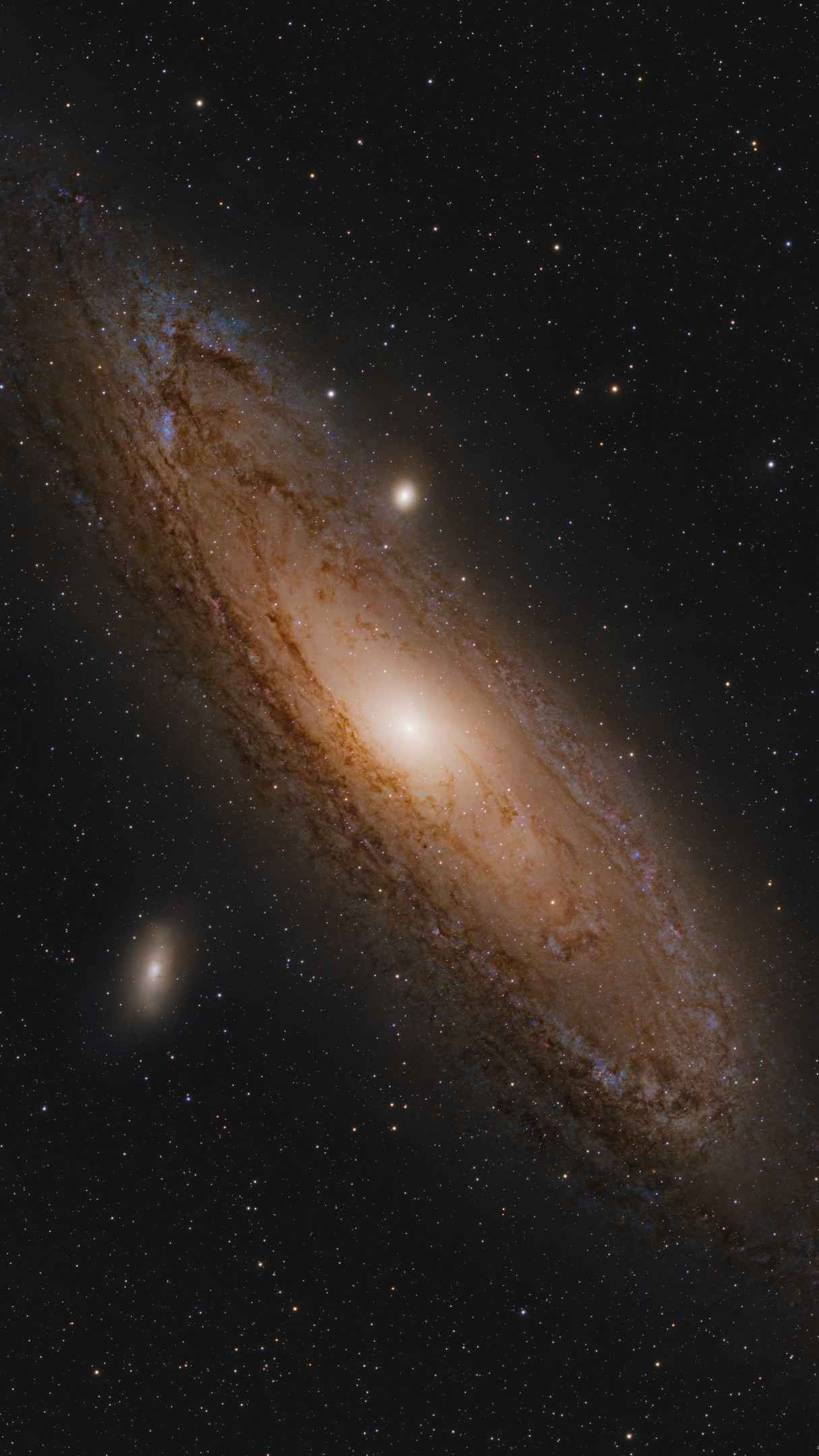
M31 Andromeda galaxy
- Integrazione | 116 ore e 40 minuti in IRCUT
- Seestar Collective | 2025
- Telescopio | ZWO Seestar S50
- Drizzle | No
M31, the Andromeda Galaxy — our closest large galactic neighbor and one of the most extraordinary objects visible from Earth.
Located about 2.5 million light-years away in the constellation Andromeda, it spans an immense disk of stars, dust, and gas more than 6 times wider than the Moon in our sky — so large that it can actually be seen with the naked eye under a truly dark sky.
M81 Bode's galaxy & M82 Cigar galaxy
- Integrazione | 150 ore in IRCUT
- Seestar Collective | 2026
- Telescopi | ZWO Seestar S50 e ZWO Seestar S30
- Drizzle | No
M81 and M82 — two galaxies shaped by the same gravitational interaction, yet with completely different appearances.
M81, also known as Bode’s galaxy, is a grand design spiral galaxy about 12 million light-years away in the constellation Ursa Major. Its elegant spiral arms are filled with dust lanes and star-forming regions, giving it a calm and well-ordered structure.
Above it lies M82, the famous Cigar galaxy. Unlike M81, it appears chaotic and disturbed. The intense red outflows visible around its core are enormous streams of hydrogen gas pushed outward by extreme star formation activity. This “starburst” behavior was likely triggered by a close gravitational interaction with M81 millions of years ago.
Faint integrated flux nebulae can also be seen across the field, illuminated by the combined light of the Milky Way.


Markarian's Chain
- Integrazione | 94 ore e 17 minuti in IRCUT
- Seestar Collective | 2026
- Telescopio | ZWO Seestar S50
- Drizzle | x1
Markarian’s Chain — one of the most fascinating regions in the Virgo Cluster, where a single field of view opens a window onto an extraordinary concentration of galaxies.
This area is best known for the apparent “chain” formed by several bright members of the Virgo Cluster, including M84 and M86, along with many other neighboring galaxies scattered across the frame. The effect is striking: a dense gathering of island universes, each one made of billions of stars, all suspended in a seemingly quiet patch of sky that is actually overflowing with structure.
M33 Triangulum galaxy
- Integrazione | 8:39 ore in IRCUT
- Seestar Collective | 2025
- Telescopio | ZWO Seestar S50
- Drizzle | 1x


M94 Croc's Eye galaxy
- Integrazione | 82 ore e 16 minuti in IRCUT
- Seestar Collective | 2025-2026
- Telescopio | ZWO Seestar S50
- Drizzle | x2
M94, the Croc’s Eye galaxy, is a nearby spiral galaxy in the constellation Canes Venatici, about 16 million light-years away.
It’s often classified as a starburst galaxy because of the intense star formation in its inner region, which appears as a very bright and compact core. Around it, there’s a large and faint outer halo — but this isn’t dust: it’s made of stars. A huge extended stellar structure that makes M94 quite unusual compared to typical spirals.
The small “spots” visible across the image are not noise or artifacts, but distant background galaxies, far beyond M94.
NGC 6946 Fireworks galaxy
- Integrazione | 24 ore e 59 minuti in IRCUT
- Adriano Alfaro & Vineet | 2025
- Telescopio | ZWO Seestar S50
- Drizzle | x2
NGC 6946, also known as the Fireworks galaxy, is a fascinating spiral galaxy located on the border between the constellations Cepheus and Cygnus, about 25 million light-years from Earth.
Its nickname comes from the unusually high number of supernovae observed within it over the past century: as many as 10 stellar explosions, making this galaxy a natural laboratory for studying stellar death.
Its surface brightness is very low: invisible to the naked eye, but remarkable when revealed through long-exposure imaging.

Galleries
Explore the astrophotography categories
Nebulae
HII regions, emission and reflection nebulae, and supernova remnants.
Galaxies
Spiral, elliptical, irregular, and interacting galaxies.
Planetary nebulae
Shells of gas expelled by dying stars.
Open clusters
Groups of stars formed from the same molecular cloud.
Solar system
The Moon, Sun, planets, and comets.
Milky Way
The Milky Way, constellations, and wide regions of the sky.
Auroras
Luminous phenomena in Earth’s atmosphere.
Dark nebulae
Clouds of interstellar dust.
Globular clusters
Dense groups of stars.